Is Your Parquet Floor Crying Out for Help? Five Signs It Needs Professional Restoration
Parquet flooring isn’t just another hardwood surface; it’s an intricate mosaic of hand-laid timber blocks—often oak, walnut or teak—arranged in timeless patterns such as herringbone, chevron or basket-weave. Installed correctly, a parquet floor can last well over a century, but only if it receives the periodic expert attention it deserves. Ignore early warning signs and minor defects snowball into costly structural repairs.
Below we reveal five clear signs your parquet floor is crying out for professional parquet floor restoration—and why DIY stop-gaps seldom solve the underlying issues.
Quick takeaway: If more than one sign below sounds familiar, booking a free site survey could save thousands in future repairs.
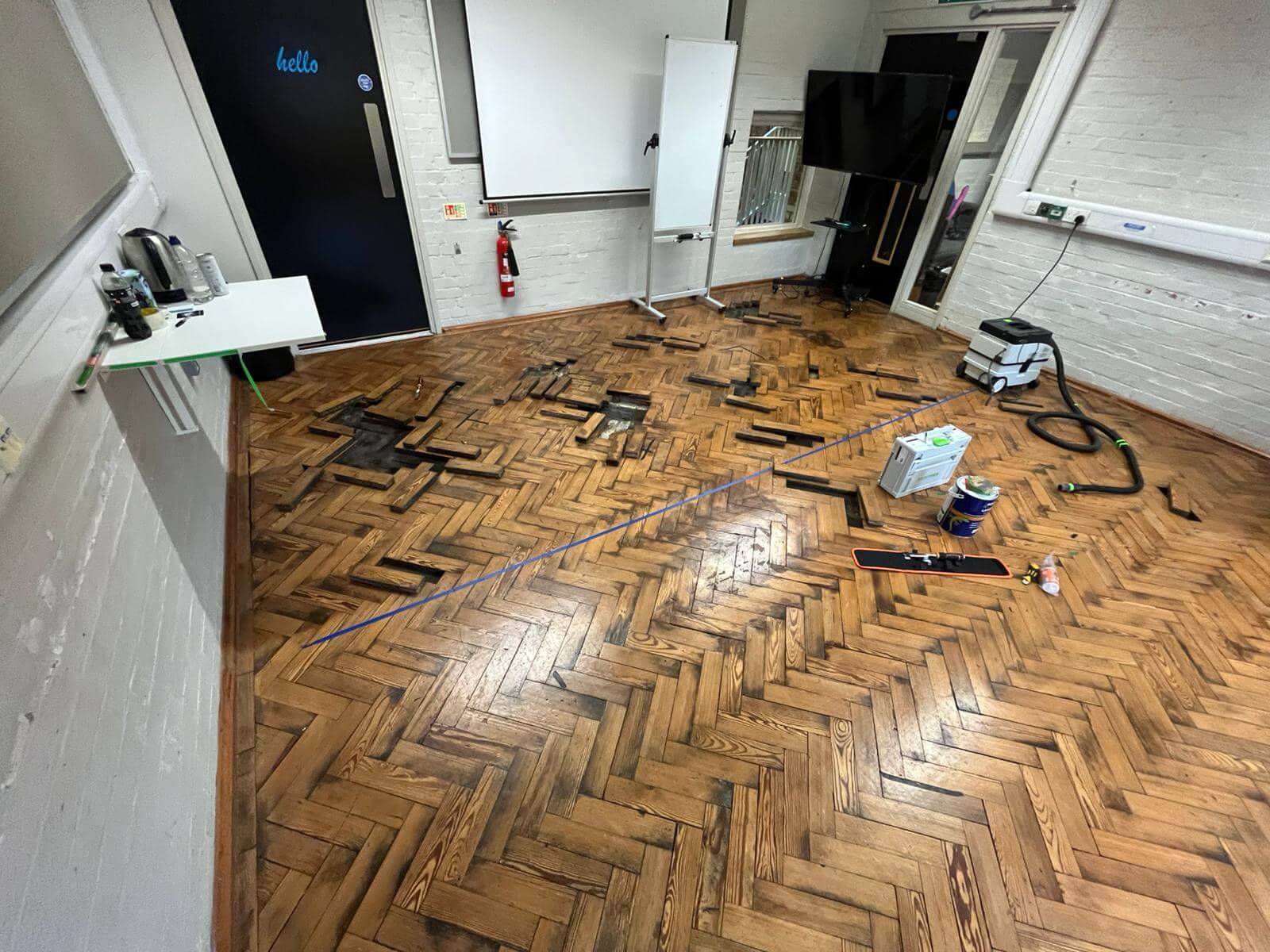
Sign 1 – Loose, Lifting or Hollow-Sounding Blocks
Key symptoms:
- Blocks that rock underfoot or lift at the corners
- A hollow “drum” sound when you tap individual pieces
- Fine dust working its way up through joints
Loose blocks rarely stay that way for long; vibration from foot traffic widens the gaps, inviting dirt and moisture to undermine adjoining pieces. Often the culprit is ageing bitumen adhesive—common in pre-1970s installations—that has gone brittle and lost its grip.
Why professional help matters:
- Adhesive upgrades: Modern elastomeric parquet adhesives remain flexible for decades, bonding securely to concrete or timber substrates.
- Sub-floor assessment: Pros identify underlying moisture or structural movement before re-bonding, preventing repeat failures.
- Dust-free lifting: Specialist lifting irons and low-heat guns remove stubborn bitumen without scorching blocks—protecting crisp, square edges for a seamless re-lay.
Image suggestion: Close-up of a parquet block being gently lifted with a flooring iron (alt = “Technician lifting loose oak herringbone block during restoration in Hampstead”).
Sign 2 – Deep, Worn-Through Scratches & Gouges
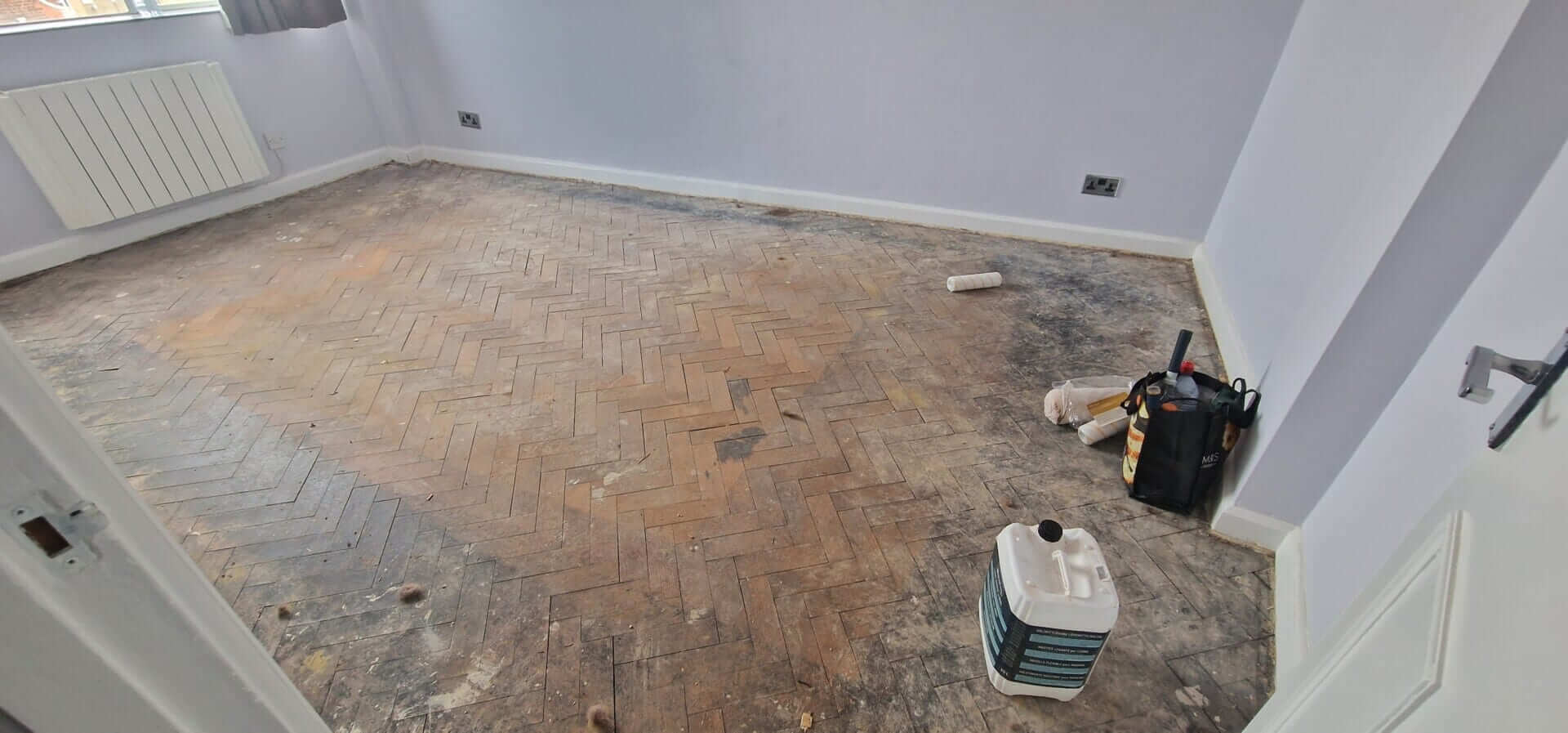
Parquet’s small block size means the surface is intersected by many joints. When a chair leg or pet’s claws scratch through the finish, dirt collects along these lines, turning a light scuff into a dark, unsightly groove. DIY floor sanding with a hire-shop drum sander often causes dishing—the blocks’ softer late-wood is removed faster than the harder early-wood, leaving a wash-board surface.
Professional fix:
- Precision belt sanders level the surface in fine increments, preserving pattern crispness.
- Edge machines treat skirts and radiator pipes so the floor sits absolutely flush.
- Micro-gouges are filled with colour-matched resin for an invisible repair.
Pro tip: If scratches reach the raw timber, bacteria stain the grain black within days. Fast intervention prevents permanent discolouration.
Sign 3 – Gapping, Draughts & Chilly Rooms
Traditional parquet blocks shrink across the grain in low-humidity winters and expand in damp summers. When the original bitumen loses elasticity, joints stay open, creating visible V-shaped gaps that funnel cold air from below.
Why you shouldn’t ignore gaps:
- Heat loss increases energy bills by up to 15 %.
- Dust and pet hair accumulate, triggering allergies.
- Edges become vulnerable to chipping under stiletto heels.
How specialists solve it:
- The floor is acclimatised under controlled humidity to reach equilibrium.
- Gaps under 4 mm are filled with hot pine slivers—thin wedges glued edge-wise, then trimmed flush.
- Wider gaps or missing blocks are replaced with reclaimed timber of matching grain and age, ensuring a perfect colour blend after sanding.
Image suggestion: Craftsman inserting pine slivers between oak blocks (alt = “Gap filling with pine slivers on parquet floor to stop draughts”).
Sign 4 – Dark Water Stains & Discolouration
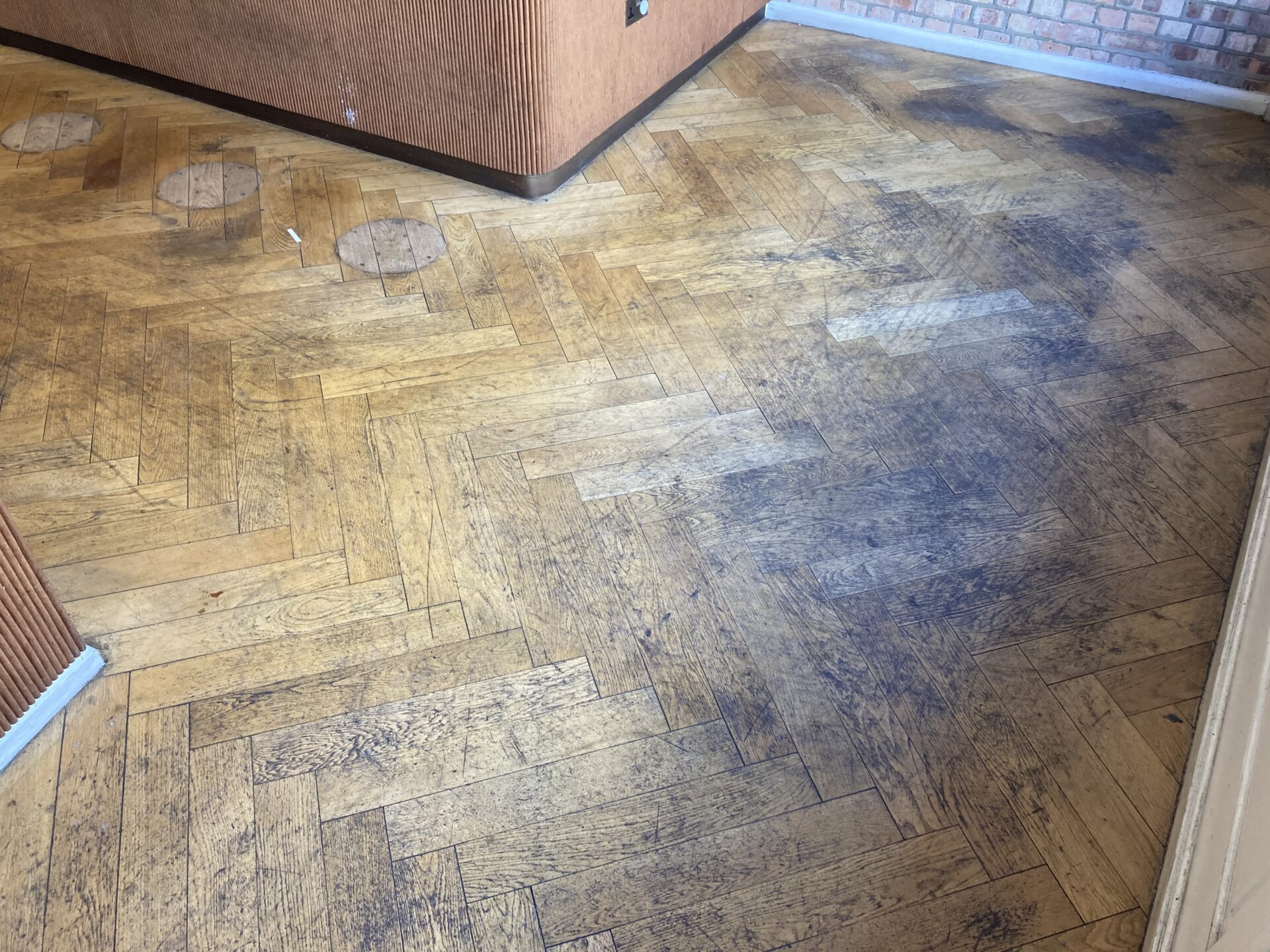
A leaky radiator, flowerpot or fridge can leave tell-tale black rings on parquet. Water reacts with the tannins in oak, causing iron-oxide staining that sinks deep below the finish. Left unchecked, the blocks soften, swell and push neighbouring timber aside.
Restoration roadmap:
- Moisture mapping reveals the spread and depth of saturation.
- Affected blocks are carefully removed, kiln-dried or replaced.
- Oxalic-acid poultices draw out dark mineral stains before sanding.
- The entire floor is sealed with moisture-hardening primer and two coats of commercial-grade lacquer or hard-wax oil.
Did you know? An insurance claim often covers professional parquet restoration after plumbing leaks—ask our team for guidance on paperwork.
Sign 5 – Dull, Patchy or Flaking Finish
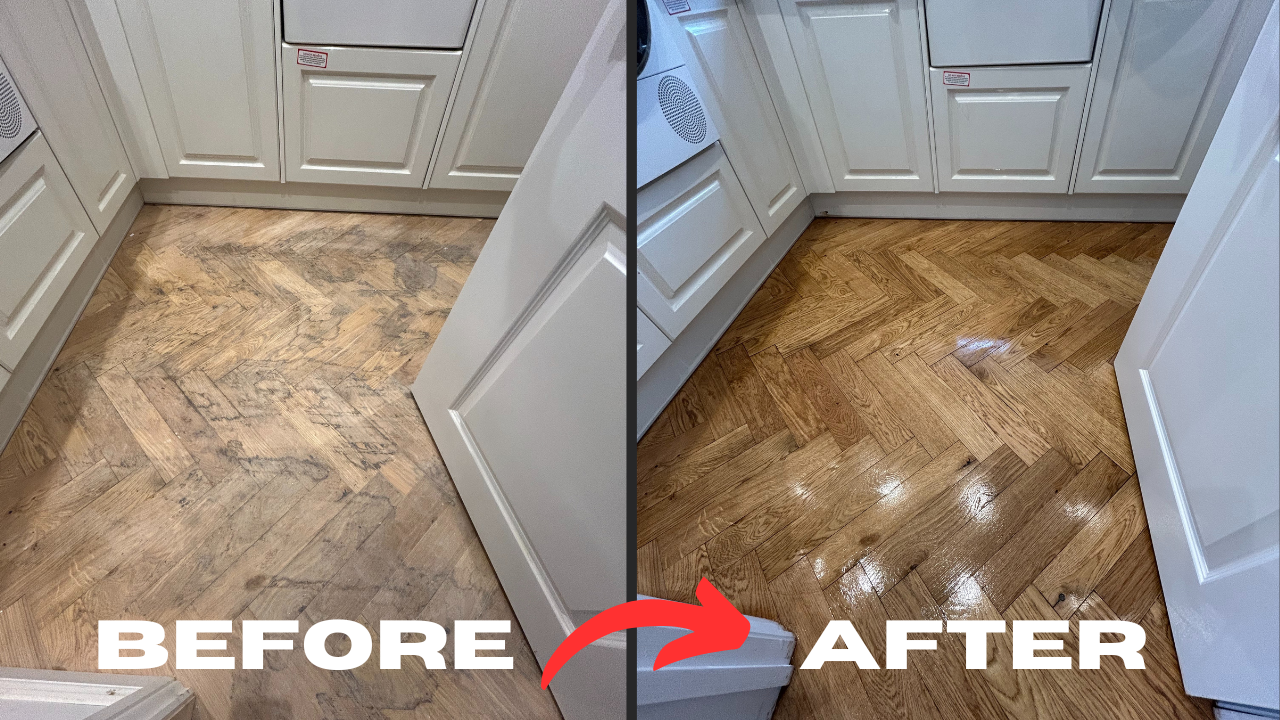
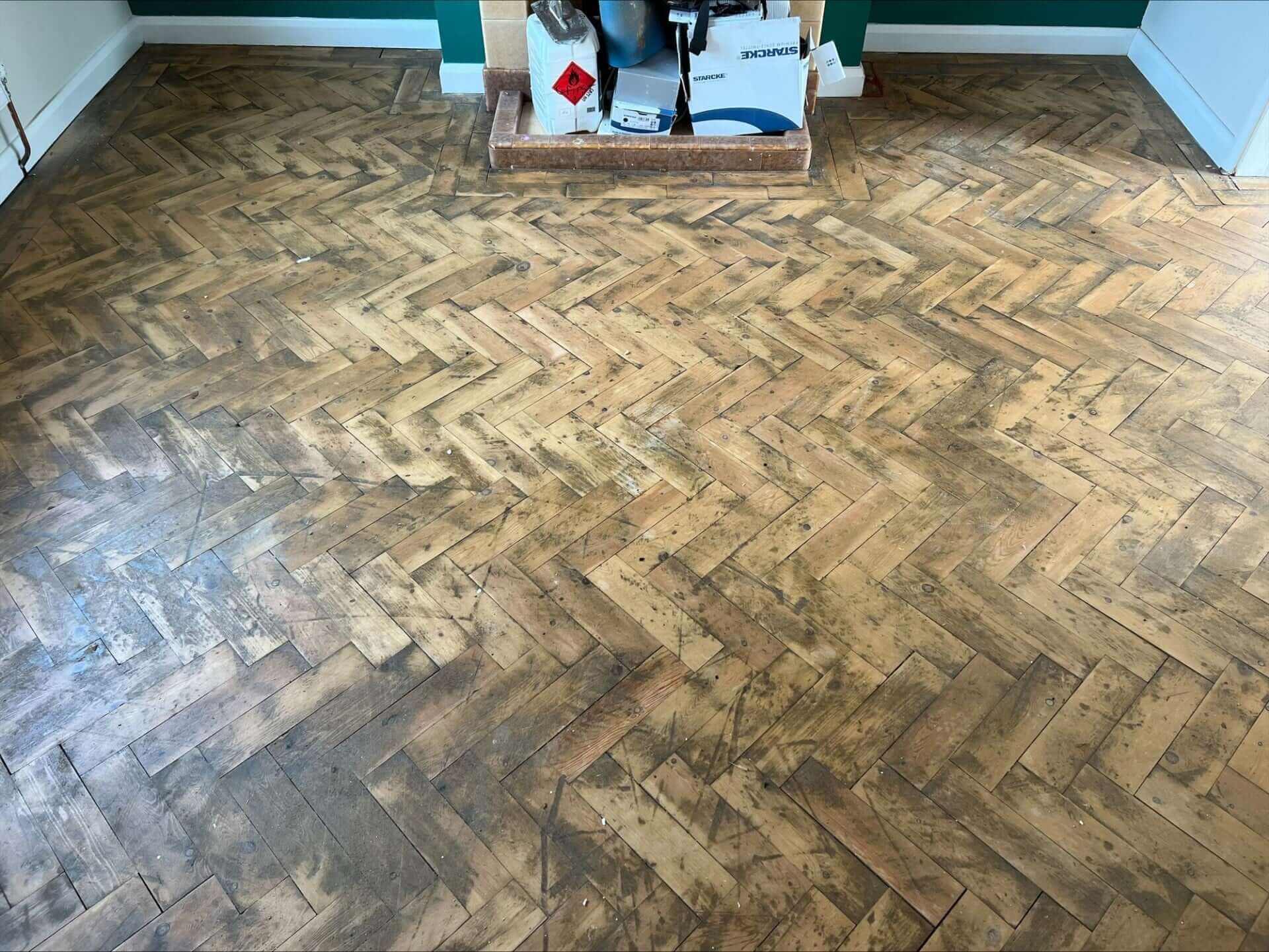
When parquet loses its sparkle even after a thorough clean, chances are the protective finish has thinned beyond its serviceable life. In high-traffic walkways the lacquer wears away first, leaving a patchy, grey halo. Sunlight further degrades exposed timber, so a simple “top-coat” re-varnish will leave new finish sitting on a bleached base—resulting in an uneven tone.
Expert solution: A full-depth, dust-free sand removes every trace of the old coating before an even application of fresh finish. Modern finishes cure in 24 hours and withstand heavy footfall for 7–10 years with routine maintenance.
Maintenance hack: Position doormats at external entrances and felt pads under furniture to double the life of your new finish.
The Hidden Benefits of Timely Professional Restoration
| Benefit | DIY Outcome | Professional Outcome |
|---|---|---|
| Lifespan extension | 3–5 years | 10–15 years |
| Energy efficiency | Minimal impact | Up to 15 % heat-loss reduction |
| Property value | Neutral | Adds 2–3 % to resale price |
| Indoor air quality | Dust trapped in gaps | HEPA-filtered sanding removes allergens |
| Aesthetics | Surface visible swirl marks | Champagne-smooth finish |
Beyond the eye-catching results, clients report lower heating bills, healthier living spaces, and an uplift in property valuations—helpful if you’re considering refinancing or selling.
Our Proven Six-Stage Parquet Restoration Process
- Free Site Survey & Moisture Testing – We identify structural issues and provide a fixed quotation.
- Block Repair & Re-Bonding – Loose blocks are lifted, cleaned and re-laid with flexible adhesive.
- Gap Filling – Resin or pine slivers eliminate draughts and create a monolithic surface.
- Dust-Free Sanding – Progressive grits (40–120) flatten, smooth and prepare the wood.
- Staining & Colour-Matching – Optional bespoke tints accentuate grain or complement décor.
- Finishing & Curing – Two-pack lacquer or penetrating hard-wax oil, cured for maximum durability.
Internal link suggestion: Learn more on our Parquet Floor Restoration Service page.
Why Choose Hampstead Floor Sanding?
- 30 years’ specialist experience with Victorian, Edwardian and Art-Deco parquet.
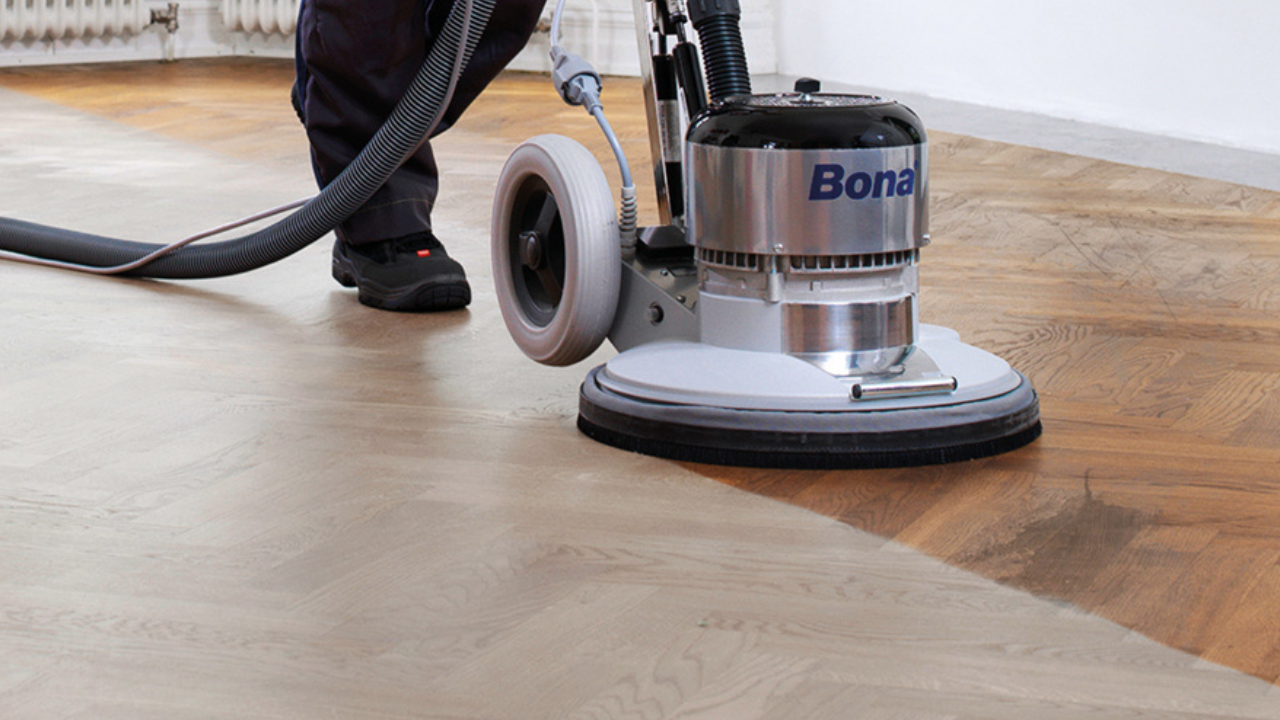
- Bona and Pallmann certified operators using HEPA triple-filter extraction.
- Sustainably sourced replacement blocks and low-VOC finishes safe for children & pets.
- Weekend and evening appointments—minimal disruption to busy households.
- Five-year workmanship guarantee for peace of mind.
We’re proud members of the Federation of Master Builders and Checkatrade, boasting a 9.9/10 customer rating.
Frequently Asked Questions
Q1: How often should parquet be professionally sanded?
Every 10–15 years in a typical Hampstead family home, or sooner in high-traffic commercial spaces.
Q2: Will dust ruin my furniture?
Our continuous-bag extractors capture 98 % of airborne particles; we also isolate the work zone with plastic sheeting.
Q3: How long before I can walk on the floor again?
Light sock traffic the next day; furniture after 72 hours once the finish has fully cured.
Q4: Can you match missing blocks in rare woods?
Yes. Our reclaimed-timber partners stock over twelve species, allowing near-invisible repairs.
Q5: Do you offer maintenance packages?
Annual buff-and-recoat plans from £4 per m² keep your parquet looking showroom-fresh.
Ready to Revive Your Parquet?
Book your free parquet health check today.
Call 020 7313 7515 or request a callback online—our surveyor will bring moisture meters, colour samples and 30 years of know-how straight to your doorstep.
Don’t wait until tiny cracks become trip hazards. Let Hampstead Floor Sanding restore your parquet to its original grandeur—silky-smooth, draught-free and built to last another generation.